


FOR STRAWBERRIES
Microbial inoculant for Fragaria × ananassa
Your strawberry has been in the ground for months and won't take off.
Don't take our word for it: leave your own untreated control and compare.
ALOMYXA® is a microbial inoculant with strain ALO-2010 of Bacillus amyloliquefaciens and Macrocystis pyrifera extract. It complements your fertilization program at every stage of the crop — from transplant to second-year reactivation — and does not replace it. It is not a pesticide.
Is your plant investing in leaves
but not in roots?
A strawberry plant can look lush and full above ground while having a severely limited root system that holds everything else back: establishment, runners, flowering, fruit. These are the four scenarios that repeat most in the field.
The plant has been stalled for months
Transplants four or five months in the field that won't break dormancy — no runners, no daughter plants, no visible production. The problem isn't the variety or the fertilizer: it's biological activity in the root zone.
Tired soil, sparse secondary roots
Intensive cycles with heavy agrochemical loads reduce the soil's beneficial microbiome. Without fine, active roots, applied nutrients don't reach their potential — no matter how much you invest in fertilization.
Second-year plants with no vigor
At the start of the second cycle, many plants enter the productive season with exhausted root systems. Without an intervention that reactivates root health, second-year yields fall well short of their potential.
Markets demanding less chemistry
Export and organic production require certified bioinputs that hold up to audits without compromising agronomic performance. Not every product passes that test.
What does ALOMYXA® do
in the strawberry rhizosphere?
ALOMYXA® combines Bacillus amyloliquefaciens proprietary strain ALO-2010 with seaweed extract from Macrocystis pyrifera. Together they activate six critical processes in the Fragaria × ananassa root from the very first contact with the soil.
Immediate rhizosphere colonization
Bacillus amyloliquefaciens establishes in the root zone from transplant. It forms biofilms that occupy the rhizosphere and create a biologically stable environment that supports the plant's uptake of the nutrients present in the soil solution.
Exopolysaccharide production
Scientific literature documents that strains of Bacillus amyloliquefaciens form biofilm and release exopolysaccharides in the rhizosphere, where improved nutrient uptake may support crop performance. (Scientific information about the species; not an efficacy statement for ALOMYXA®, which has no published own trial with an untreated control.)
Greater nutrient efficiency
A biologically active rhizosphere can contribute to phosphorus solubilization and support the plant's uptake and use of the nutrients already present in the soil solution.
Soil microbiome activation
Strain ALO-2010 not only acts directly but also supports the activity of beneficial microorganisms already present in the soil, building a root ecosystem that persists and strengthens with continuous applications.
Marine algae extract
The Macrocystis pyrifera extract contributes alginates, mannitol and betaines.
What is the difference between a bacterial inoculant and a biofertilizer for strawberries?
A biofertilizer supplies nutrients directly from an organic or microbial source. A bacterial inoculant like ALOMYXA® does not supply nutrients: it activates the biological processes in the soil that make existing or applied nutrients more efficiently available to the plant. They are complementary tools, not substitutes.
When is it most critical to apply an inoculant in strawberries?
The most critical moments are transplant (root dip for colonization from day one), weeks 1–4 of establishment (weekly drench), and flowering and fruit set (peak root demand). In stalled plants, the first application can be the difference between a crop that reactivates and one that never takes off.
The difference starts
where you can't see it.
Field images documented in commercial Fragaria × ananassa orchards in Michoacán, Mexico. The root is the first indicator that the bioinput is working.
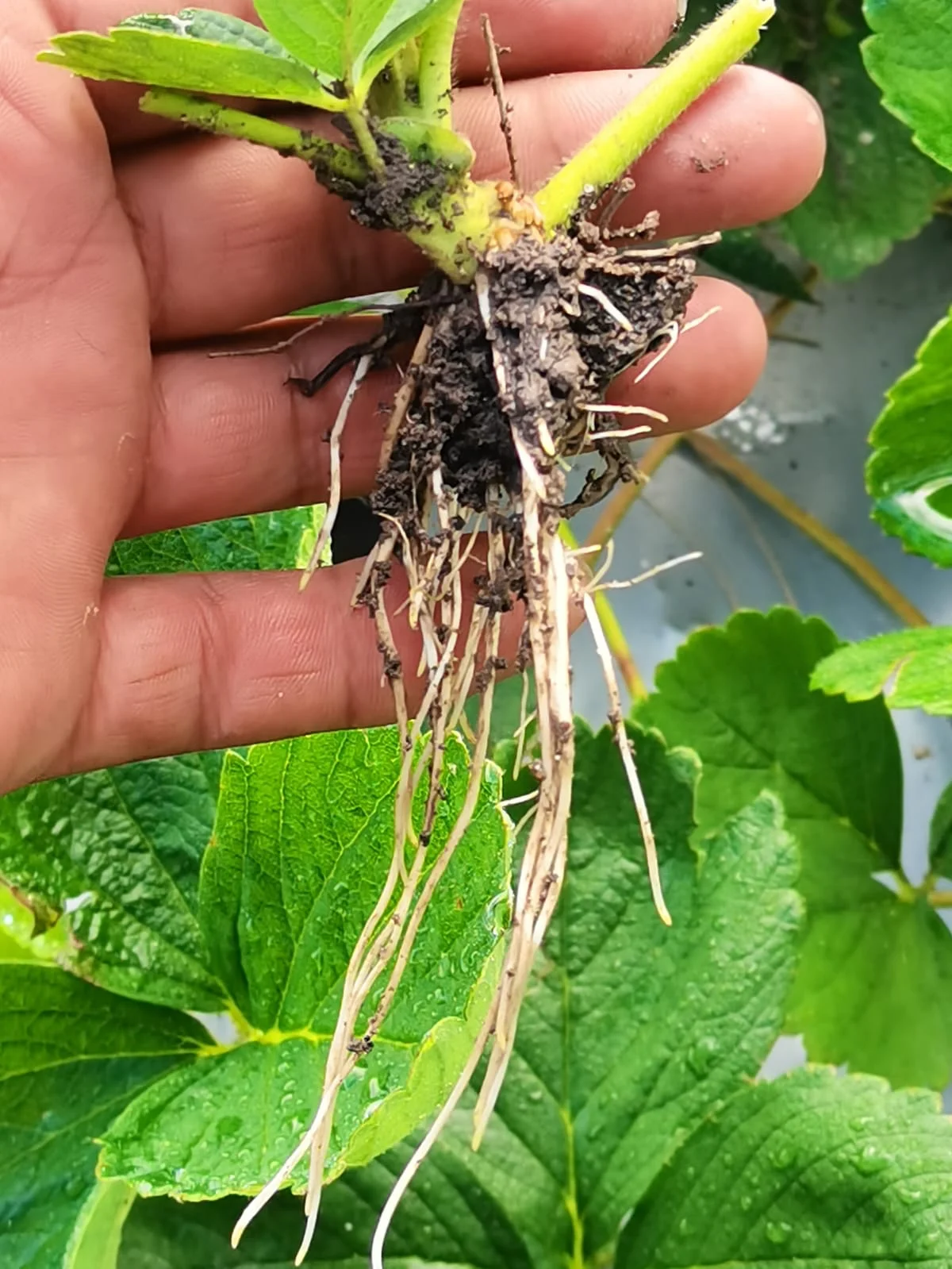
Abundant root from the moment of the runner cutting
Michoacán, Mexico · Clay soil · Commercial field
A newly planted daughter plant: just separated from the mother plant and already showing dense, long, abundant new root formation. Clay soil. ALOMYXA® applications from the moment the runner was set in the ground.
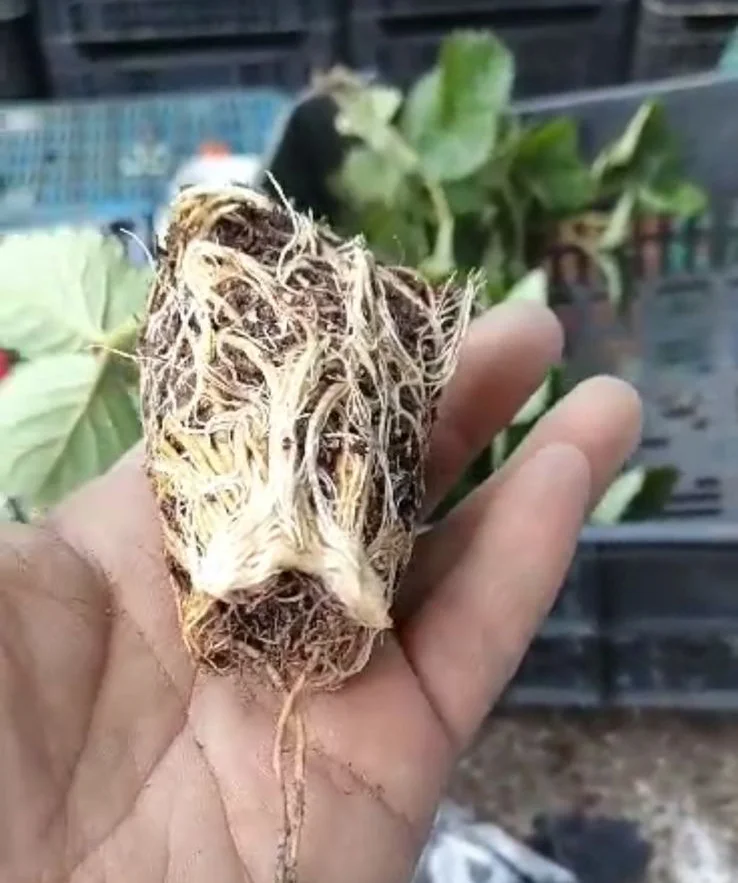
Root development in substrate — container result
Michoacán, Mexico · Substrate production
Root ball treated with ALOMYXA® in container production. The root mass uniformly and densely fills the container volume, with abundant white, active secondary roots. Contrasts with uninoculated root balls from the same batch.
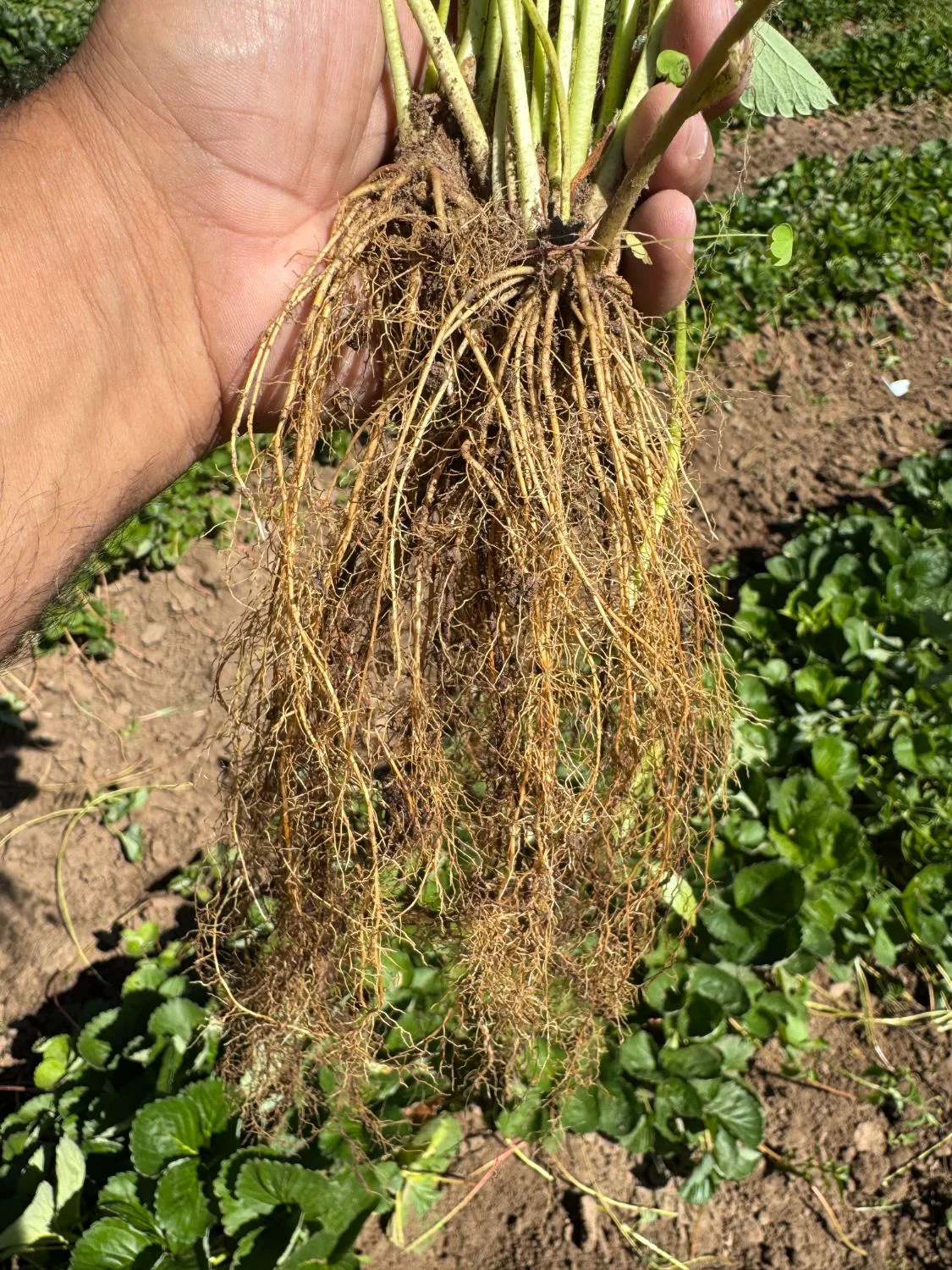
Active rhizosphere — secondary roots in direct soil
Michoacán, Mexico · Commercial field · Direct soil
Rhizosphere development in a direct-field plant. The density of fine, vigorous secondary roots visible here is characteristic of Fragaria × ananassa's response to colonization with strain ALO-2010 in agricultural soil.
Want to see this result in your field?
Receive the application protocol specific to Fragaria × ananassa and real agronomic support from our team.
Plants that wouldn't take off.
Documented week by week.
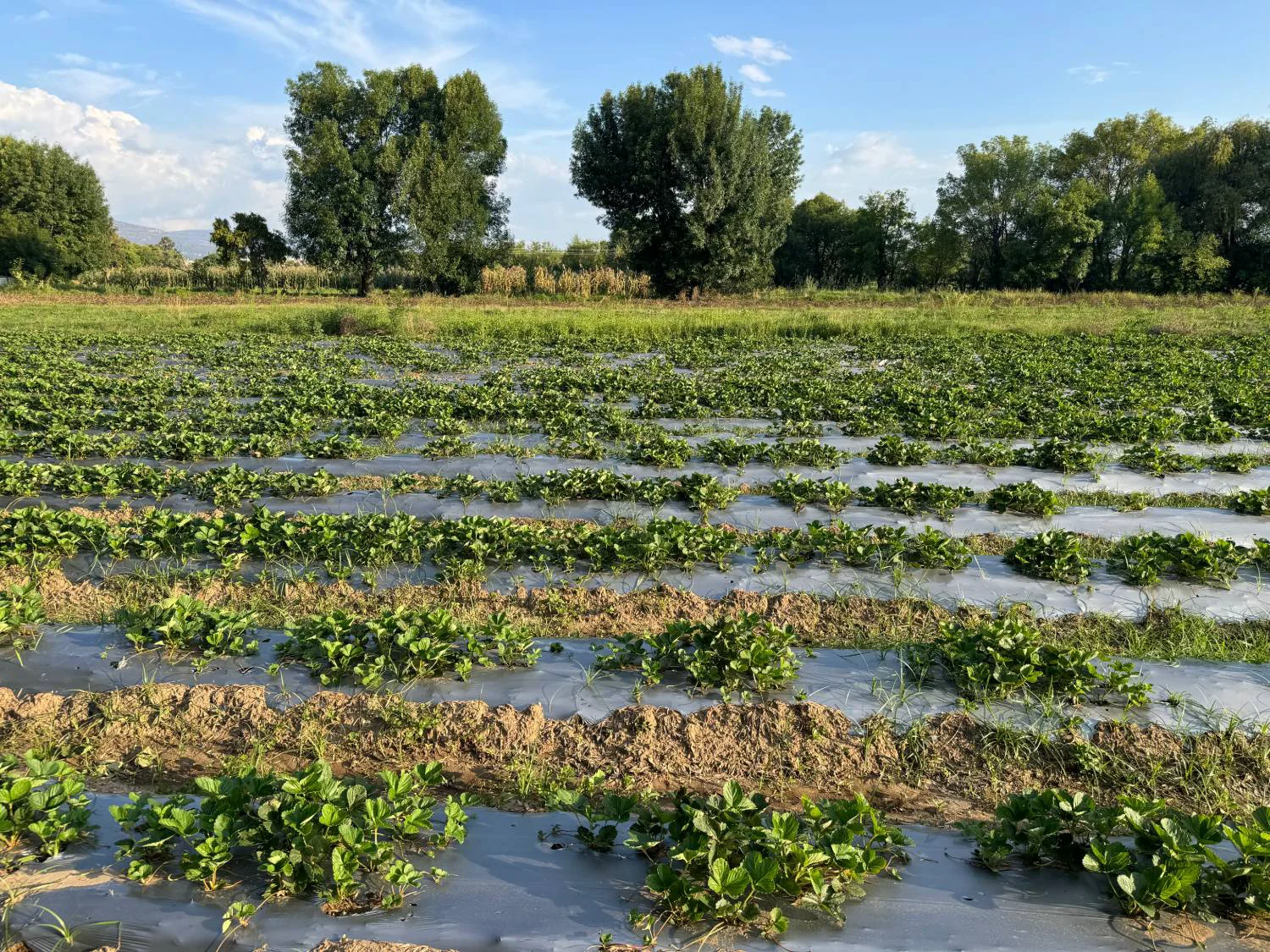
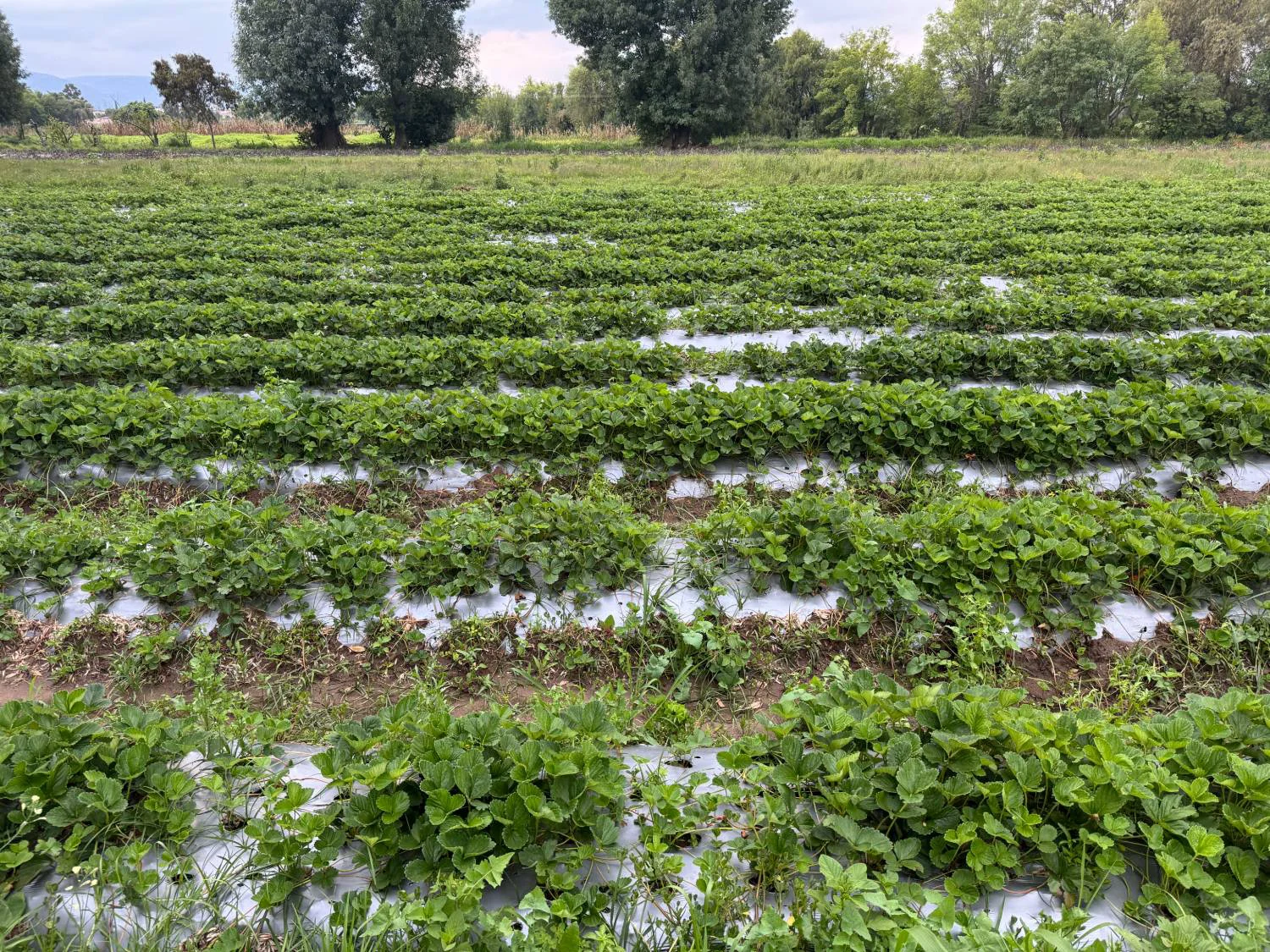
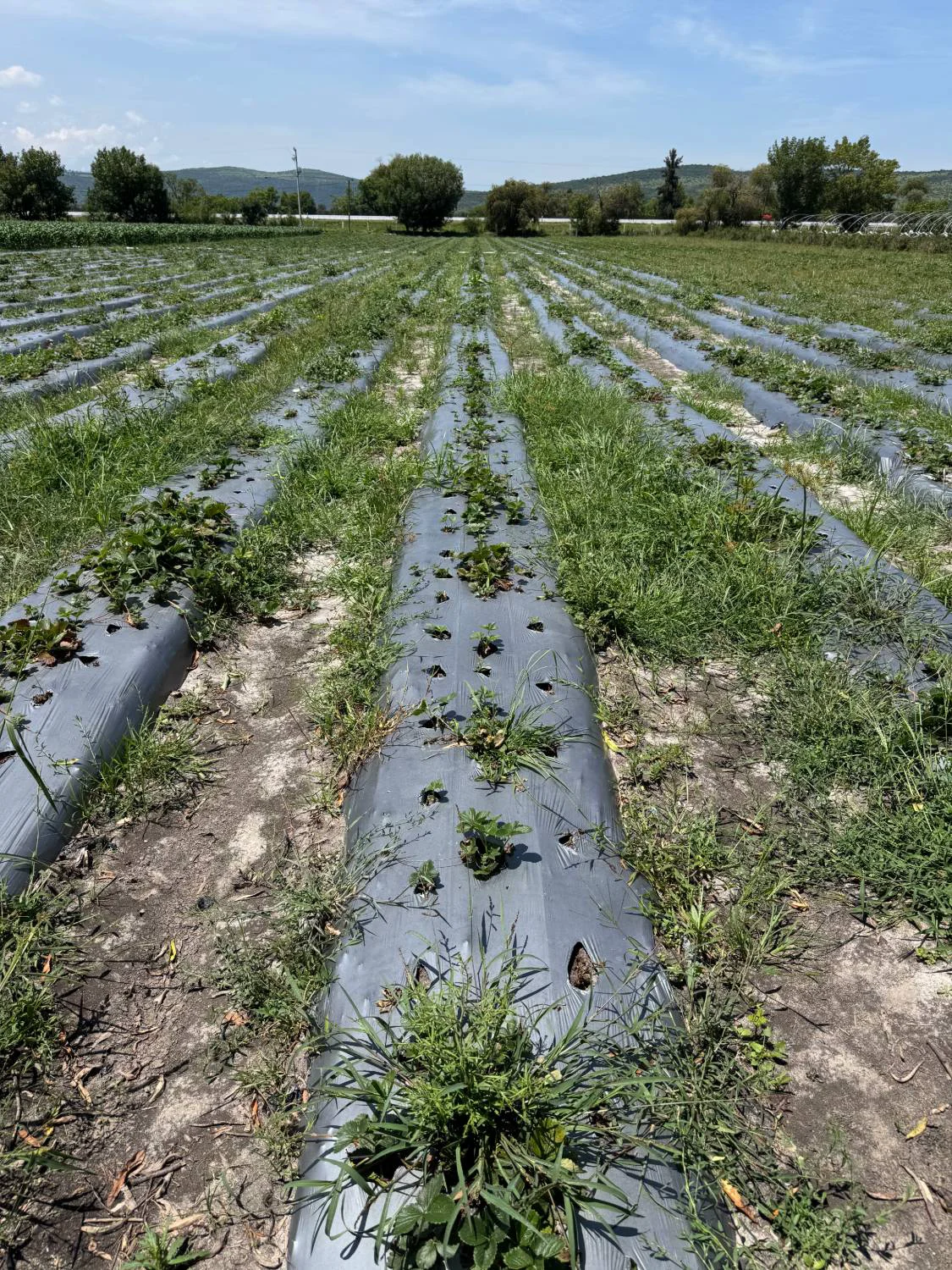
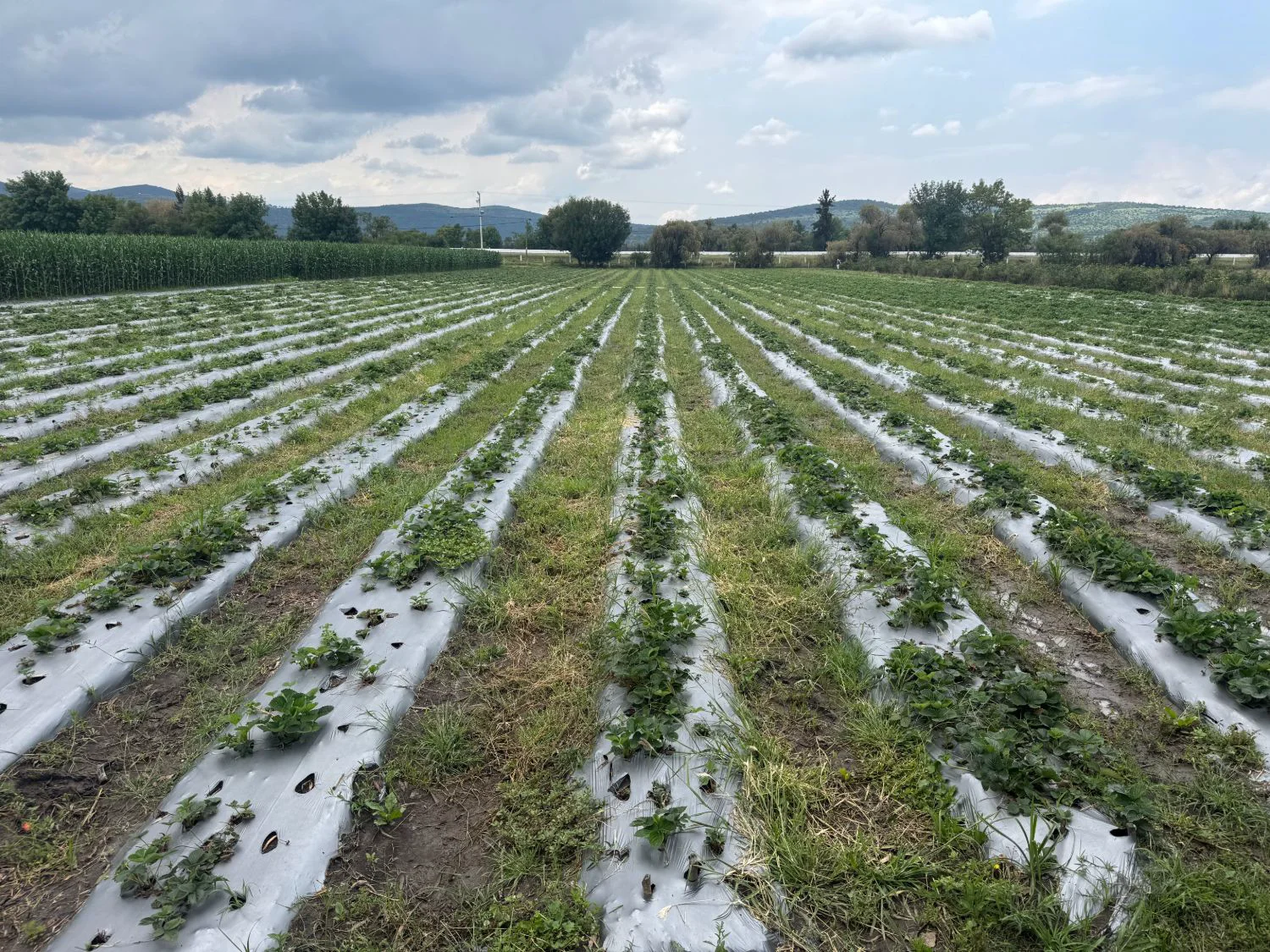
The two progressions below show crops that had been stalled for months when ALOMYXA® applications began. Dates are field-documented. These are not recent transplants: they are plants that had stopped growing weeks before.
Progression at 4–5 months post-planting — Day 0, Day 21, Day 60
Strawberry crop under bimetallic mulch (silver exterior, black interior). Plants four to five months in the field with no growth or production at the time applications began.
Michoacán, Mexico · Commercial field · Bimetallic mulch
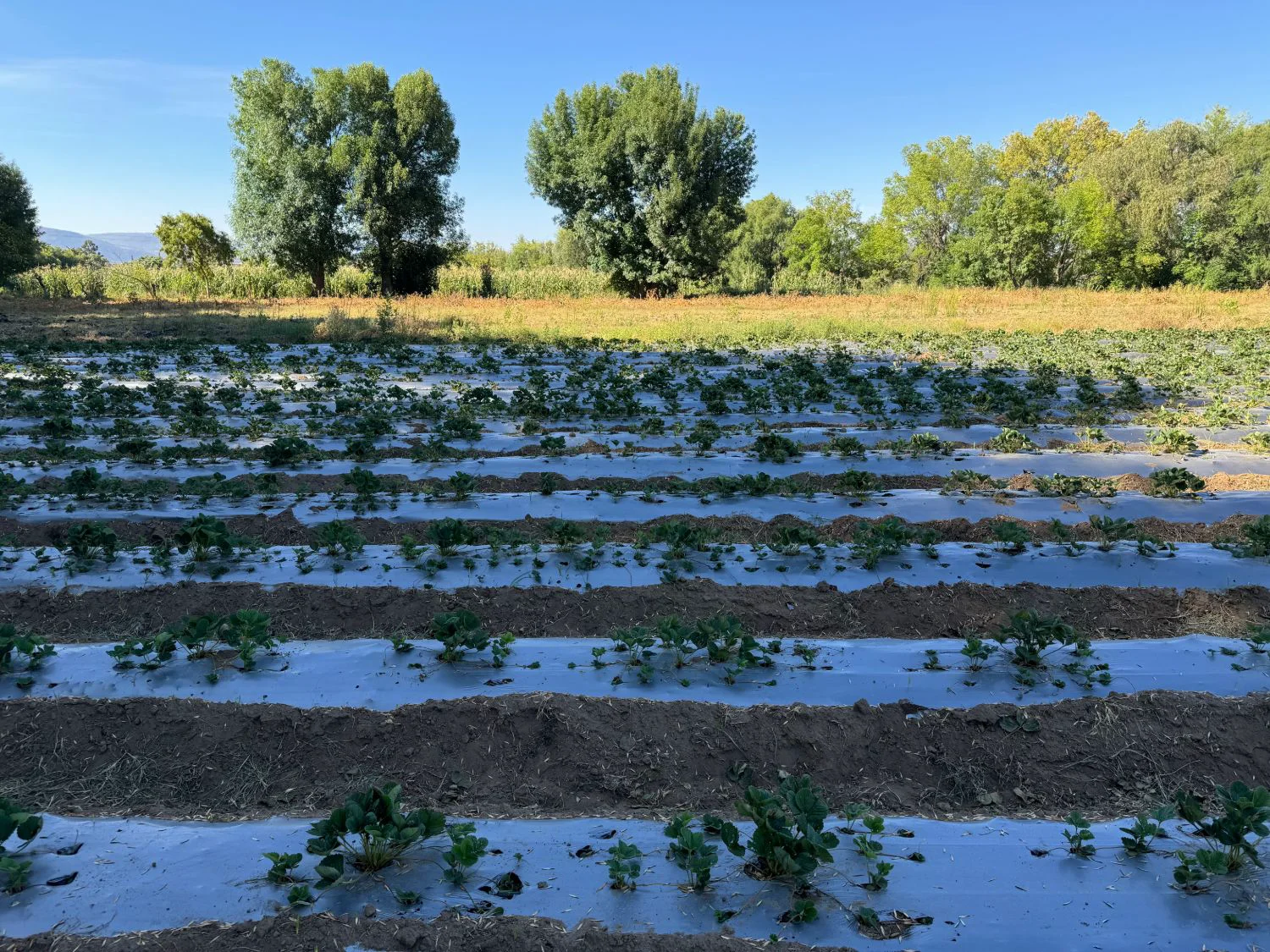
Progression at 3–4 months post-planting — Day 0 and Day 28
Second documented case. Plants three to four months in the field under bimetallic mulch. No vegetative growth, no runners, no stolons at program start.
Michoacán, Mexico · Commercial field · Bimetallic mulch
An active root feeds
flower, shoot, and fruit at the same time.
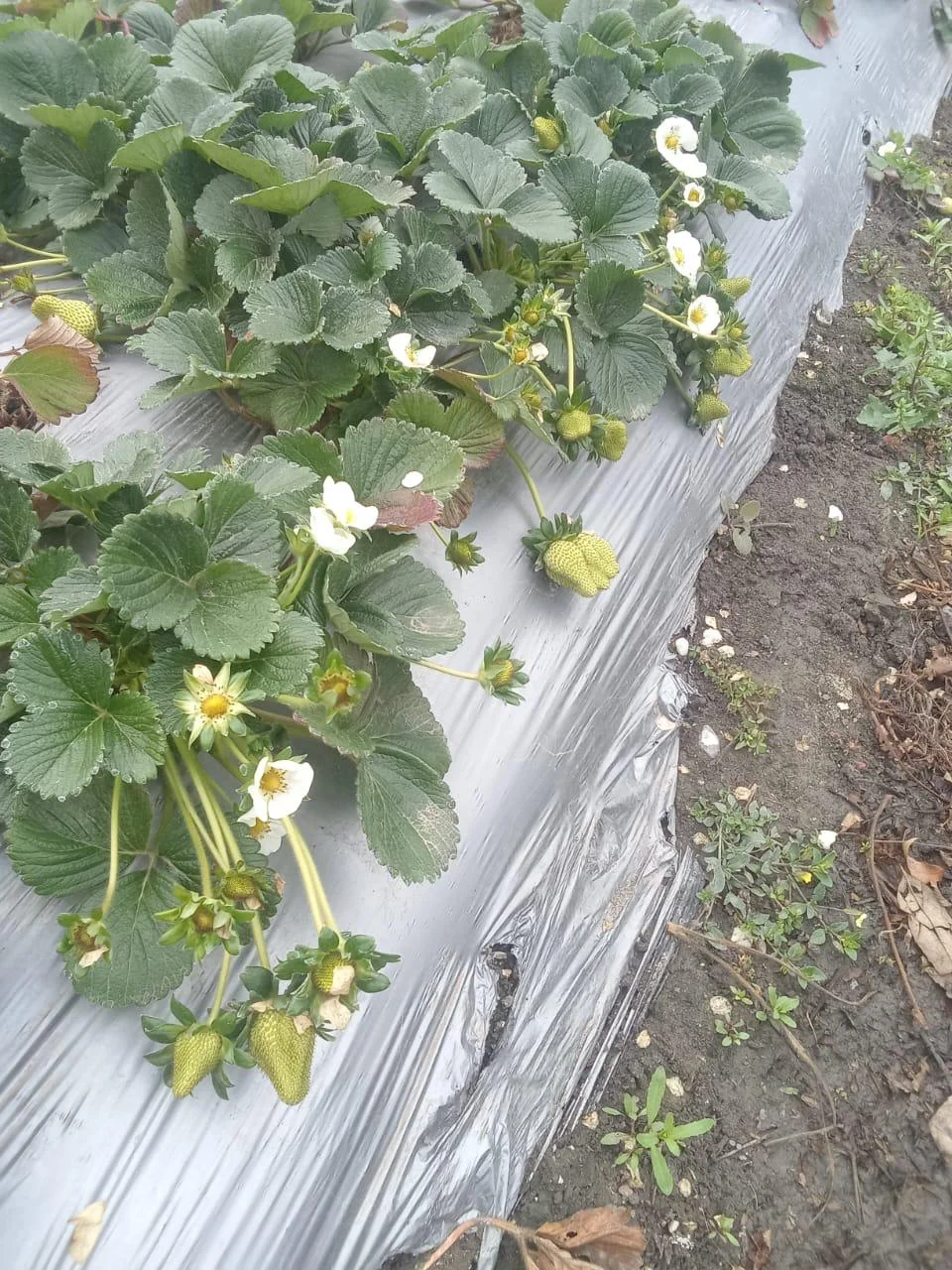
Flower, shoot, and fruit in simultaneous growth
Michoacán, Mexico · Commercial field
This image shows simultaneously: abundant flowering, new vegetative shoots, and fruit in full development. It is the result of nutrient availability generated by a biologically active rhizosphere through continuous ALOMYXA® applications.
The plant does not concentrate its energy on a single process: it can flower and fruit while producing new runners, thanks to the greater absorptive capacity of the root system.
Abundant flowering with high density of buds and open blooms.
Fruit in visible development at multiple simultaneous stages.
New shoots and young leaves — sustained vegetative growth.
Result of recurring applications that keep the rhizosphere active.
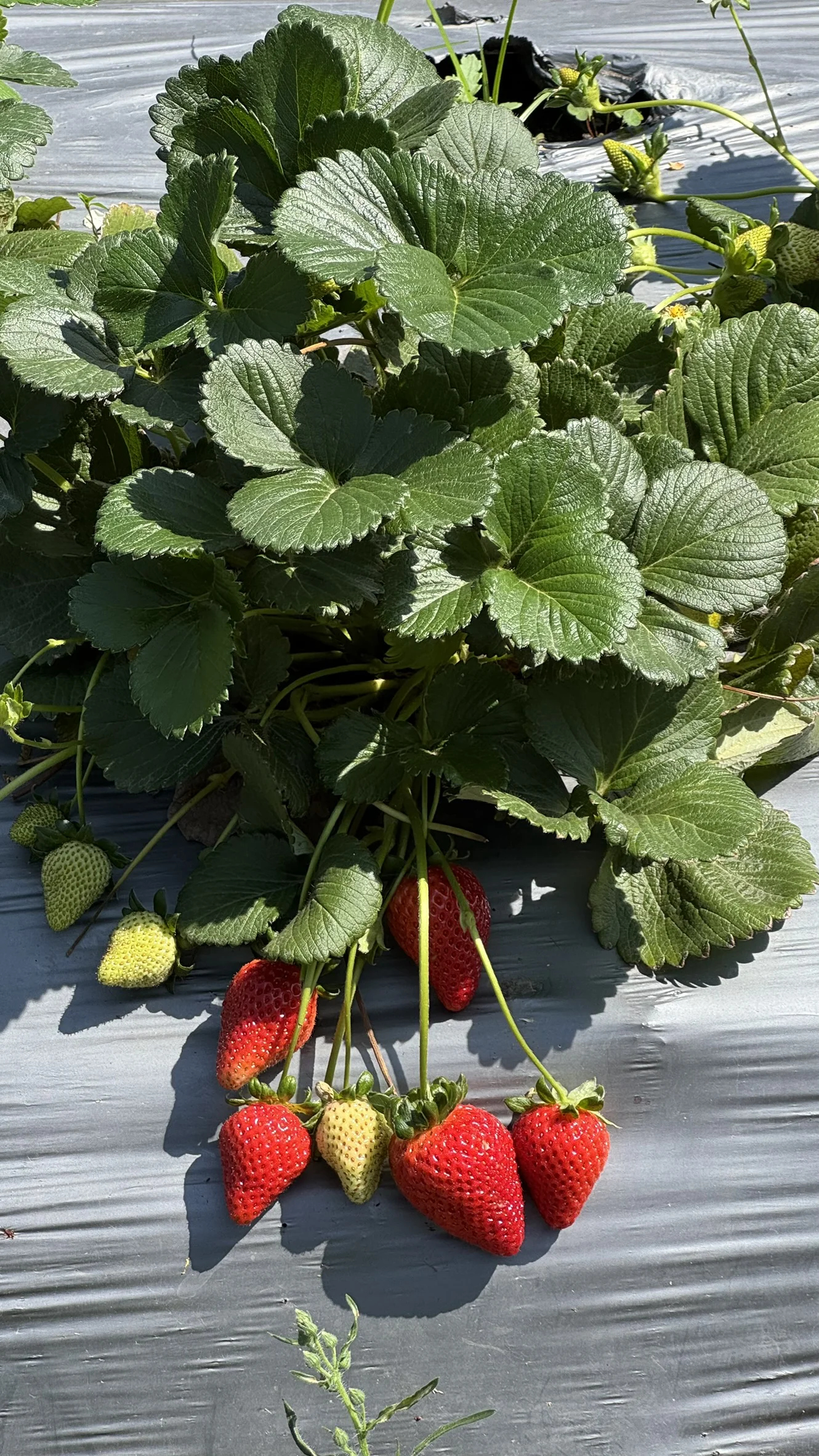
Fruiting with sustained vegetative vigor
Michoacán, Mexico · Commercial field
Plant in full fruiting with multiple fruits at different ripening stages simultaneously. Fruit production does not halt vegetative growth: both processes occur in parallel, supported by a biologically active root system.
Red, turning, and green fruit on the same plant — staggered, continuous harvest.
Dense, dark green foliage — a sign of sustained vegetative activity.
Bimetallic mulch — real commercial field conditions.
ALOMYXA® supports the strawberry
at every stage of its cycle.
This is not a one-time application product. Continuous application is what keeps the rhizosphere active and accumulates biological benefit stage by stage.
Transplant
Root dip in tank (2 L / 100 L water). Strain ALO-2010 colonizes from the first soil contact, so the inoculant is present in the root zone from day one.
Establishment (weeks 1–4)
Weekly drench at the base of the plant (2–3 L/ha). This is the most vulnerable stage: the root needs continuous support to anchor and branch in its new soil.
Vegetative Stage — Runners and Daughter Plants
Weekly fertigation (4 L/ha). The plant's energy goes into runners, stolons, and new daughter plants. A root kept active with sustained inoculant produces higher-quality daughter plants from the very first runner cutting.
Flowering and Fruit Set
Continuous fertigation (4 L/ha). Flowering is the stage of highest nutritional demand. A biologically active rhizosphere supports uptake of the critical nutrients needed for successful fruit set.
Fruiting and Harvest
Continuous fertigation. Developing fruit demands constant absorption. Maintaining an active rhizosphere during ripening supports nutrient uptake at that stage.
Second Year — Reactivation
At the start of the second cycle, resume applications from the first week. In commercial fields in Michoacán, growers with a continuous program reported the emergence of new runners and greater plant vitality at the start of the season.
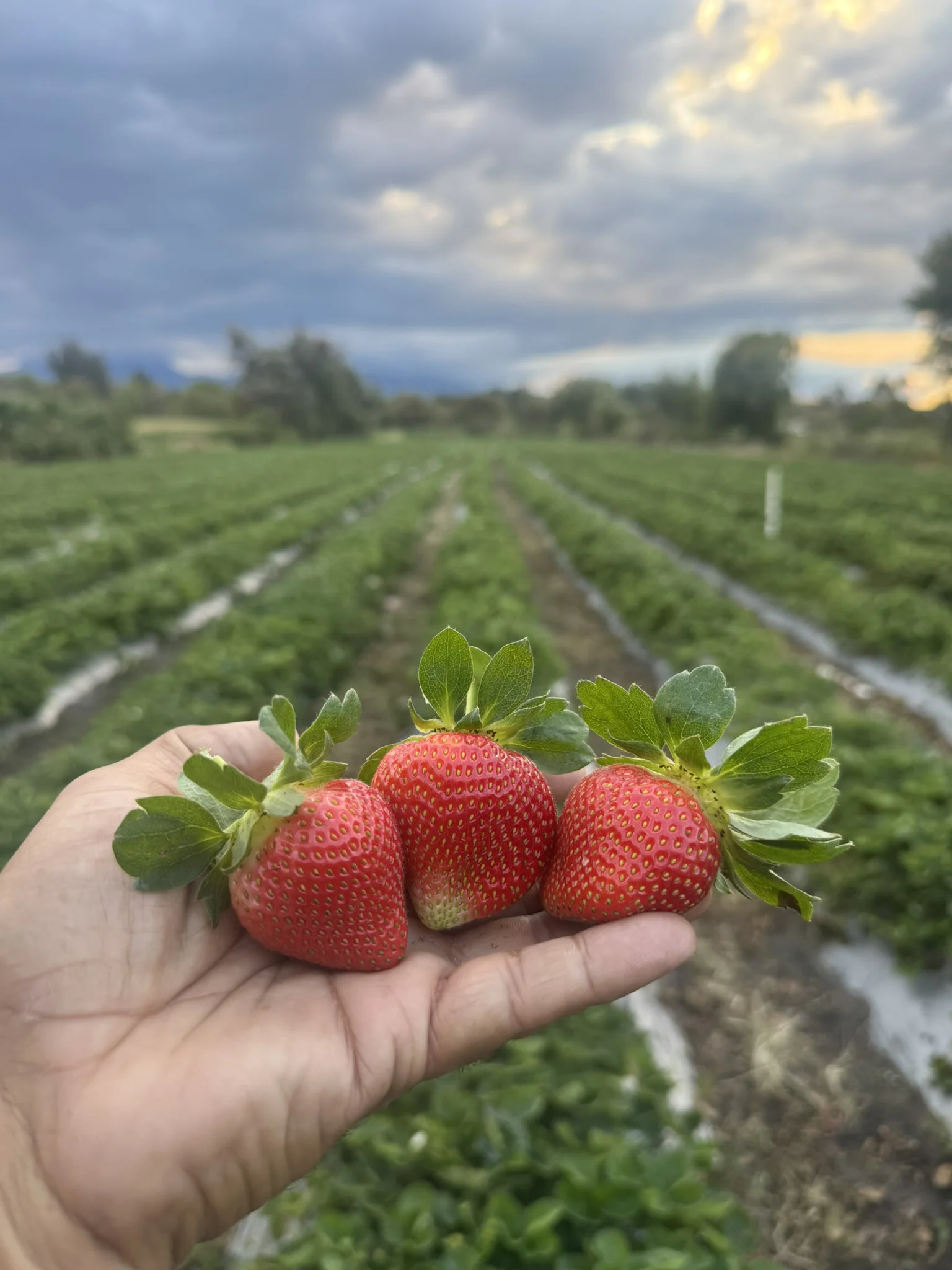
Fruit quality in a second-year crop
Strawberries harvested from an orchard with continuous ALOMYXA® applications through the second productive cycle. The size, uniformity, and color of the fruit are the visible result of a root system that did not become exhausted in the first year.
Michoacán, Mexico · Commercial field · Second year of production

Specific dosage for
Fragaria × ananassa
Protocol used in commercial fields in Michoacán. Rates may be adjusted based on irrigation system, soil type, phenological stage, and program objectives. Consult with your agronomic advisor before starting.
Rates shown are guidelines and may vary based on field conditions, irrigation system, temperature, soil type, and phenological stage. See the complete technical protocol or contact the Nutrisurco® advisory team. Do not mix with disinfectants, free chlorine, or biocides. It is not a fertilizer and it is not a pesticide: it complements your fertilization program and does not replace it. OMRI Listed® — allowed for use in organic production under the USDA NOP; it does not certify the product or endorse its efficacy.
Questions about compatibility or dosage for your farm?
Our technical team answers specific questions about your irrigation system, soil type, and crop stage.
What growers ask
before they start.
What does Bacillus amyloliquefaciens do in the strawberry root zone?
Scientific literature documents that strains of Bacillus amyloliquefaciens colonize the root surface, form biofilm and release exopolysaccharides, and have been studied under abiotic stress conditions —salinity, water deficit and temperature— where improved nutrient uptake may support crop performance. (Scientific information about the species; not an efficacy statement for ALOMYXA®, which has no published own trial with an untreated control.)
Does ALOMYXA® work on strawberry plants that have been stalled for months?
In commercial fields in Michoacán, in plots of plants 3 to 5 months in the ground with no vegetative growth, after 28 days of continuous ALOMYXA® applications the appearance of new shoots and runners was observed. This is a dated and located field observation under those conditions — not a guarantee and not a promised timeline. Don't take our word for it: leave your own untreated control and compare.
Is ALOMYXA® compatible with fertigation in strawberries?
Yes. ALOMYXA® integrates directly into drip or tape fertigation. Avoid direct mixing with disinfectants, free chlorine, peroxides, or biocides, as these can reduce Bacillus amyloliquefaciens viability. The timing and application window compatible with fertilizers is determined with the agronomic advisor responsible for the nutritional program.
Does ALOMYXA® work for strawberries in containers, substrate, or semi-hydroponics?
Yes. It can be used in systems with organic substrate (coco coir, peat moss, mixes) and in semi-hydroponics. Dosage is adjusted to the solution's electrical conductivity, substrate type, and technical objectives of the program. The photographic evidence in containers shown on this page reflects results observed under substrate conditions. Validation with the production unit's agronomic advisor is recommended.
Does ALOMYXA® benefit second-year strawberry plants?
In commercial fields in Michoacán, growers who maintained the application program cycle after cycle reported the emergence of new runners and greater plant vitality at the start of the second year. This is a reported field observation under those conditions, not a guarantee. Resuming applications from the first week of the new cycle — without waiting for visible stress signs — is recommended.
Does ALOMYXA® replace fertilizers in strawberries?
No. ALOMYXA® is a bacterial inoculant, not a fertilizer. It does not supply nutrients directly to the soil or to the plant. Its role is to complement the nutritional program by supporting the biological soil processes that improve how efficiently the plant uses applied nutrients. It is used alongside the fertilization program, not instead of it.
Is ALOMYXA® approved for certified organic strawberry production?
ALOMYXA® is OMRI Listed® — allowed for use in organic production under the USDA NOP; it does not certify the product or endorse its efficacy. Each production unit should verify the current listing status and the specific requirements of its own certification scheme with its certifier.
At what stages of the strawberry crop can ALOMYXA® be applied?
ALOMYXA® can be applied at all stages: transplant (root dip), establishment and vegetative stage (weekly drench), runner and daughter plant formation, flowering, fruiting, post-harvest, and second-year reactivation. Continuous, sustained application is what accumulates biological benefit in the rhizosphere and results in more vigorous plants throughout the cycle.
Have a question not covered here? Our agronomy team answers on WhatsApp.
Ask nowYour strawberry deserves a root
that has its back.
Request the application protocol for Fragaria × ananassa with technical support included. The Nutrisurco® team supports you from transplant through harvest.